
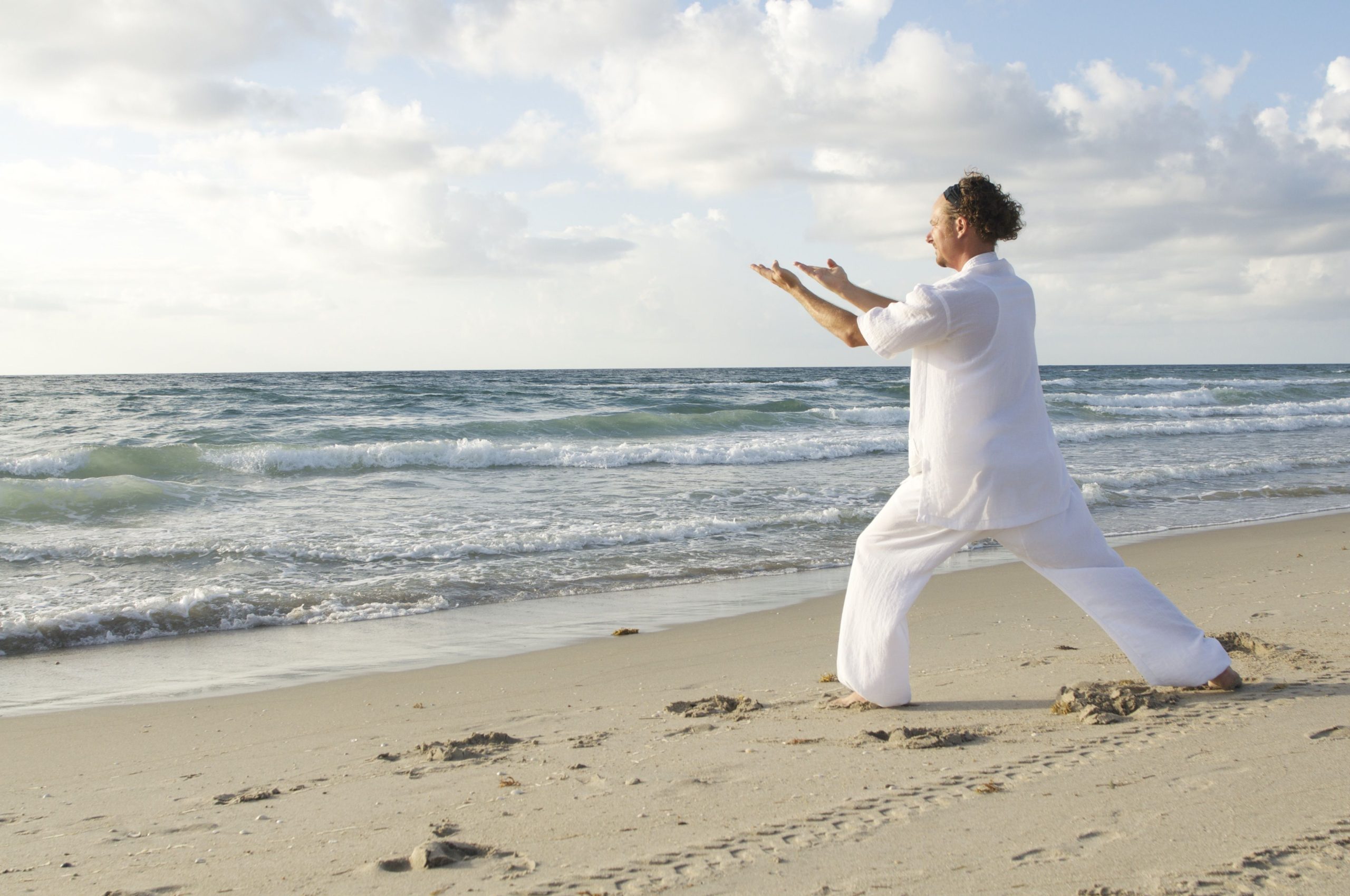
I have recently picked up Tai Chi and find myself moderately obsessed with the practice.
For many years, I have been an avid meditator. I’m a mindfulness meditation instructor but I find that lately as my mind becomes more erratic and cluttered, sitting and observing my brain feels less like a practice in relaxation and more like an afternoon stroll through a haunted house of horrors.
Tai Chi, by comparison, provides an outlet for the body while also space for the mind to slow and calm. It feels like meditation, but with your body.
When I’m not indulging in mindfulness and wellness coaching practices, I provide regular continuing legal education seminars for attorneys. This means that most weeks, I have the opportunity to speak to lawyers all over the country and provide some semblance of education on topics relevant to our lives as attorneys (or recovering attorneys, in my case).
In one particular presentation this summer, I found myself talking about cortisol and the effects of stress on our bodies.
I discussed how many of us live in environments characterized by high stress and high pressure where our stress response is activated over and over again, often without a breath of an opportunity for recovery.
In that space, our body temporarily shifts resources toward systems that help us respond to that immediate stressor (i.e., survive). In that space, our heart and lungs kick it up a notch and we become more focused on immediate threats. At the same time, functions not directly connected to survival, like digestion become less of a priority and the adulty parts of our brain responsible for things like perspective, cognitive flexibility and deliberate decision-making can become less effective.
For instance, when running from tigers, it is essential that your heart and lungs supply the necessary fuel for a speedy escape. In contrast, there isn’t room for bathroom breaks when running for your life so, naturally, our digestion slows down. What’s more, no one will be needed you to complete any math equations while you run for your life, so those parts of our brain don’t operate as well under stress.
Our stress response is not entirely a bad thing, particularly where tigers are involved, but also in situations when your in-box is screaming at you, you are on a tight deadline, you’re trying to manage the competing schedules of your clients, your partner, you children, and your nanny, or simply trying to juggle the 103 things you promised yourself you would get done by 4:30pm today.
Unfortunately, as I was attempting to eloquently state in my seminar to rapt attorneys nationwide, prolonged or intense stress can take its toll. Research reveals that stress can impair some of the most essentials skills needed by most professionals: executive function, memory, judgment, attention, and decision-making.
It was this experience of constant heightened stressed–and my sudden inability to relax and simply be without feeling tremendous amounts of anxiety–that led me to more seriously explore meditation and yoga nearly 20 years ago.
Meditation, like many mindfulness practices, is not something you master. Rather, it is a lifelong education that you never graduate from. Hence, why it’s called a practice.
For whatever reason, during this current season of my life, my meditation practice feels unachievable on some days and laughable on most others.
I think this is why Tai Chi has felt so appealing.
The fully body, intentional meditation feels so much more accessible.
Have you ever met someone who’s into CrossFit and all they ever do is talk about is CrossFit? I am the Tai Chi version of that.
I seem to find myself telling everyone about it. In fact, if you are someone who works with me in real life, you are probably rolling your eyes right now because I have been encouraging you to join us every Saturday morning.
Yet, the more I invite conversation on Tai Chi, the more I have noticed a pattern.
When I mention Tai Chi (or meditation of any kind) people often respond:
“I could never sit still for that long.”
“There’s no way I could stop my brain long enough to enjoy that.”
And maybe that’s true.
Maybe you simply don’t like meditation.
But I’ve started wondering whether sometimes there is something else underneath that response.
Because what happens when we slow down?
When there is nothing to accomplish?
When no one needs anything from us?
When we’re not checking something off a list?
When we aren’t solving a problem, producing something, answering an email, exercising, cleaning, working, planning, scrolling or otherwise filling the space?
For some people, stillness feels peaceful.
For others, it feels deeply uncomfortable.
And I don’t think we should necessarily interpret that discomfort as evidence that something is wrong with us. But I do think it can be useful information.
Our bodies are remarkably good at adapting to the environments we repeatedly put them in. If your life requires constant urgency, stimulation and responsiveness, it makes sense that slowing down might not feel immediately natural.
That doesn’t mean your nervous system is “broken.”
It doesn’t mean you’re permanently stuck in fight-or-flight.
And it certainly doesn’t mean that a casual comment about hating meditation is a diagnostic test for nervous-system dysregulation.
But it might be worth asking:
What happens inside me when I stop?
The professional world today not only rewards but seems to glamorize nonstop hustle, being stretched too thin, and cycling in and out of burnout.
Somewhere along the road, those things became evidence that we were important.
Busy meant successful.
Overwhelmed meant needed.
Exhausted meant productive.
Unavailable meant in demand.
And eventually, slowing down started to feel almost irresponsible.
We say things like, “I could never slow down enough to do something like that,” in much the same way we used to say, “I’m just such a perfectionist.”
We know there’s something less-than-positive hiding inside the statement, but we’ve learned to wield the characteristic as an attribute rather than get curious about what it’s actually costing us.
So if you’re reading this thinking, “There is absolutely no way I could sit still and meditate,” I’m not here to tell you that you have a nervous-system problem.
I’m inviting you to get curious.
What is it about slowing down that feels so uncomfortable?
What do you notice when there is nothing to accomplish?
What happens when you aren’t being productive?
What feelings or thoughts have been waiting for you in the quiet?
Maybe Tai Chi will be your thing.
Maybe meditation will be.
Maybe walking, journaling, yoga, gardening, fishing, prayer, breathwork, or simply sitting outside with a cup of coffee will give you that same experience.
The point isn’t to become someone who can sit perfectly still with a perfectly quiet mind.
The point is to create enough space to notice what happens when you don’t immediately run toward the next thing.
Because sometimes the most interesting thing we can learn about ourselves is not how well we can keep going.
It’s what happens when we finally stop.


